
That Frustrating Moment When Your Garage Door Won't Stay Closed
You press the button on your remote, watch your garage door glide downward, and then — just inches from the floor — it suddenly reverses and goes right back up. You try again. Same thing. Maybe it works on the third try, maybe it doesn't. Either way, you're standing in your driveway in Tolleson wondering what on earth is going on.
This is one of the most common garage door problems homeowners deal with, and it's also one of the most misunderstood. The good news is that there's usually a logical explanation, and in many cases the fix is straightforward. Let's walk through the most likely causes and what you can do about each one.
Understanding Why Your Garage Door Has Safety Reversals
Before we get into the specific causes, it helps to understand why your garage door is designed to reverse in the first place. Federal safety standards require all automatic garage door openers manufactured after 1993 to include two safety mechanisms: photo-eye sensors and an auto-reverse feature. These exist to prevent the door from closing on a person, pet, or object. So when your door reverses unexpectedly, it's actually doing its job — it just thinks something is in the way when nothing is.
Cause #1: Misaligned Photo-Eye Sensors
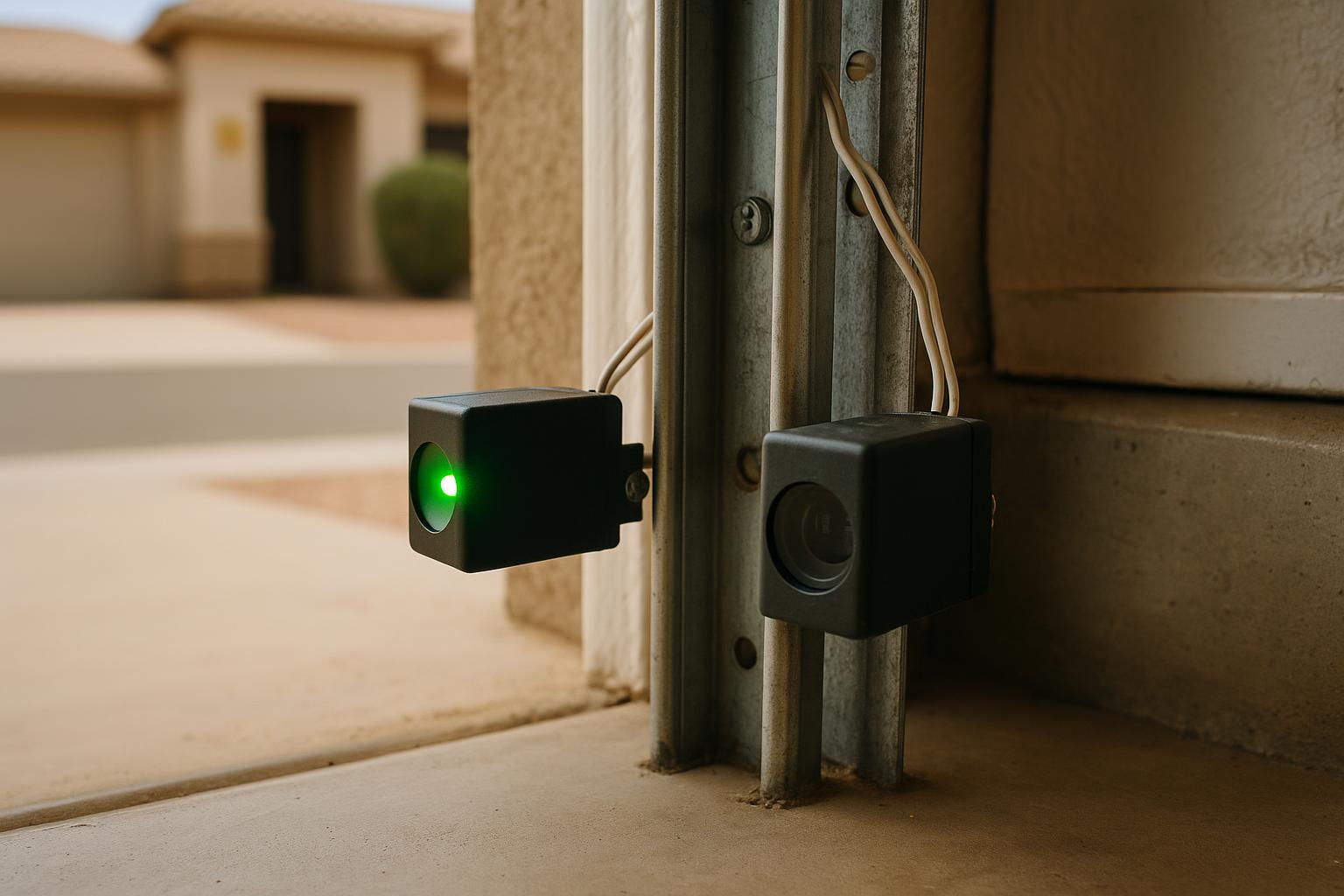
This is the number one reason garage doors reverse before closing completely. Your garage door has two small sensors mounted near the bottom of the door tracks on either side. They send an invisible beam of infrared light between them. If anything breaks that beam while the door is closing, the system triggers a reversal.
Over time, these sensors can get bumped, knocked out of alignment by a bike tire or a trash can, or simply shift due to vibration. When they're not perfectly aligned, the opener interprets the broken beam as an obstruction.
What You Can Do
- Check both sensors for a steady LED light. Most models show a green light on the receiving sensor when alignment is correct. A blinking light usually means misalignment.
- Gently adjust the sensor brackets until both lights are solid.
- Wipe the sensor lenses with a clean cloth — dust, dirt, and cobwebs can block the beam, especially here in the West Valley where dust is a constant companion.
Cause #2: Something Is Actually in the Way
It sounds obvious, but it's worth checking. A small object on the garage floor near the door's path — a shoe, a garden tool, a child's toy — can trigger the photo-eye sensors or physically obstruct the door. Even a buildup of leaves or debris along the threshold can cause problems.
Walk the full length of the door's path and clear anything within a few inches of where the door meets the ground.
Cause #3: The Close-Limit Switch Needs Adjustment
Your garage door opener has limit switches that tell it how far the door should travel in both the open and close directions. If the close-limit setting is off, the opener may think the door has hit the ground — or hit an obstacle — before it actually has. When the motor keeps pushing after the door has supposedly reached its limit, the system interprets the resistance as an obstruction and reverses.
What You Can Do
- Consult your opener's manual for instructions on adjusting the close-limit switch. On most models, it involves turning a small screw on the back or side of the motor unit.
- Make small adjustments — usually a quarter turn at a time — and test the door after each change.
- If you're not comfortable making this adjustment yourself, this is a quick fix for any qualified garage door technician.
Cause #4: Worn or Damaged Tracks
Your garage door travels along metal tracks on both sides. If those tracks are bent, dented, or clogged with debris, the door can bind or stick as it moves. The opener senses that extra resistance and reverses to protect itself and whatever it thinks is in the way.
Visually inspect the tracks from top to bottom. Look for obvious bends, gaps between the track and the wall, or any buildup of grime. Minor debris can be cleaned out with a rag, but bent tracks typically need professional attention. Trying to hammer them back into shape can make the problem worse.
Cause #5: Broken or Worn Springs
Garage door springs do the heavy lifting — literally. They counterbalance the weight of the door so the opener doesn't have to work as hard. When a spring is weakening or broken, the door becomes much heavier for the opener to manage. The motor strains, detects excessive resistance, and reverses.
If you hear a loud bang from your garage followed by the door not working properly, a spring has likely snapped. Do not attempt to replace garage door springs yourself. These components are under extreme tension and can cause serious injury. Spring replacement is one of the most common services we handle at Tolleson Garage Door Co, and it's always best left to experienced professionals.
Cause #6: Opener Force Settings Are Too Low
Your garage door opener has adjustable force settings that control how much power the motor uses to open and close the door. If the closing force is set too low, the opener may not have enough power to push the door all the way down, especially if the door is slightly older or heavier. It interprets its own lack of force as meeting an obstruction.
Like the limit switch, the force adjustment is usually a small dial or screw on the opener unit. Again, make small adjustments and test between each one. If you crank the force too high, the safety reverse feature may not work properly, which creates a real hazard.
When to Call a Professional
Some of these fixes — cleaning sensors, clearing obstructions, wiping down tracks — are perfectly reasonable for a handy homeowner to tackle on a Saturday morning. But several of these issues involve components under tension, electrical connections, or precise calibrations that are best handled by someone who works on garage doors every day.
Here are some signs it's time to pick up the phone:
- The door reverses and you've already checked the sensors and cleared the path
- You hear grinding, scraping, or popping sounds during operation
- A spring appears broken or the door feels unusually heavy when lifted manually
- The door is visibly off-track or crooked
- You've adjusted limit switches and force settings without improvement
If you're dealing with a garage door that won't stay closed in Tolleson or anywhere in the surrounding West Valley — Avondale, Goodyear, Buckeye, Litchfield Park, or Glendale — our team can diagnose the issue quickly and get it resolved. We see these problems daily, and most repairs can be completed in a single visit.
Prevent the Problem Before It Starts
Regular garage door maintenance goes a long way toward preventing unexpected reversals and other headaches. A basic annual tune-up includes lubricating moving parts, checking spring tension, testing safety features, tightening hardware, and inspecting tracks and rollers. It's a small investment that helps you avoid bigger repair bills and the frustration of a door that won't cooperate when you're trying to get to work in the morning.
At Tolleson Garage Door Co, we offer maintenance plans designed to keep your door running reliably through the extreme heat of Arizona summers and everything else the seasons throw at it. If your garage door has been giving you trouble — or if it's been a while since anyone took a look at it — give us a call. We'll make sure everything is working the way it should.